Fitting readers' needs and being aware of exposure to complex texts is a challenge. Lucy Calkins quotes Richard Allington in her book Pathways to the Common Core, "You can't learn much from books you can't read" (2002). Allington defines these books as those students can read when they demonstrate 96% accuracy, fluency, and comprehension. That challenge seems tough enough, but we also need to be exposing them (though modeling and think alouds) to those texts that are on grade level and will further our students' understanding of the standards though use of the thinking strategies. Basically, we need to have access to an arsenal of texts to use in our teaching, conferring, and classroom libraries.
So, what do you do? You seek support such as: books, booklets, colleagues, LMSs, online sites, etc. Check out sites listed below as they may make your search a little easier and support your ELA, social studies, and science contents as well. Consider them as you work to find your mini-lesson and student practice passages (those we sometimes offer them to try out before they get into their self-selected texts.) You may just find something you like that fits a variety of needs. :)
Happy Clicking!
http://teacher.depaul.edu/Nonfiction_Readings.htm Many grade-leveled passages on various content concepts 3rd -6th grade
http://www.k12reader.com/ Use the sidebar to find the grade level you are interested in finding texts for.
Monday, November 12, 2012

Saturday, November 10, 2012
Must Have New Apps
Sometimes I just find myself App Shopping. Like those times when I am trapped in the house, and the dishes sit piled in the sink waiting to be washed, I might just engage in some task avoidance and click on AppShopper or the App Store and see what catches my attention. Tonight I found several great (and mostly FREE) apps that called me to click "Install". Time might be running out, so click it yourself before you miss it!
McGraw Hill Education books: County & City Mouse, Jack and the Beanstalk, Why the Sea is Salty, and Little Red Riding Hood. These books are great for early readers who might need the book read to them, (when they need help with a word or page, or just need fluency modeled for them), or when they need a just right book to read to themselves.
Word Mover: This app was created by ReadWriteThink- the well-clicked resource we know best from our ELA units. The app "is used to supplement classroom instruction, reinforce concepts taught in class, and offer increased student engagement". Students can create "found poetry" (we might have schema for this concept though our Magnetic Poetry Center).
Book Creator: This app costs $1.99 and students can use it to create their own books, save them in iBooks, and send them via email, or submit them to the iBookstore.
Please sure your newest, greatest apps for all to see and CLICK!
Happy Installing!
McGraw Hill Education books: County & City Mouse, Jack and the Beanstalk, Why the Sea is Salty, and Little Red Riding Hood. These books are great for early readers who might need the book read to them, (when they need help with a word or page, or just need fluency modeled for them), or when they need a just right book to read to themselves.
Word Mover: This app was created by ReadWriteThink- the well-clicked resource we know best from our ELA units. The app "is used to supplement classroom instruction, reinforce concepts taught in class, and offer increased student engagement". Students can create "found poetry" (we might have schema for this concept though our Magnetic Poetry Center).
Book Creator: This app costs $1.99 and students can use it to create their own books, save them in iBooks, and send them via email, or submit them to the iBookstore.
Please sure your newest, greatest apps for all to see and CLICK!
Happy Installing!
Friday, October 26, 2012
Break It Down For Me! I Need the Info.
IF YOU HAVE NOT READ THE POST BEFORE THIS...SCROLL DOWN FIRST AND THEN READ THIS ONE. :) It will make more sense. :)
Even if you know the Mode of Focus for writing, what may not be immediately apparent is the scaffolding asked for in previous units. How much time ought I focus on ____ before I introduce _____? These photos are organized with brackets to show the length of time one might spend on a particular kind of writing. It is just another way of showing the breakdown of the year for our writers.
Did you know...the activities can be a window into the kind of writing emphasized inside of a unit. Take a minute to count the "type of writing" suggestions in the activity titles. It becomes clear pretty quickly what the unit is suggesting students spend their time learning about and trying out within the confines of those weeks. (These sample activities also offer opportunities for students to try out other types of writing so they experience variety within those five weeks or so.)
What does this kind of writing look like? Many might be surprised at the rigor expected for our K-5 kids. Click here to take a peek: http://www.corestandards.org/assets/Appendix_C.pdf
Even if you know the Mode of Focus for writing, what may not be immediately apparent is the scaffolding asked for in previous units. How much time ought I focus on ____ before I introduce _____? These photos are organized with brackets to show the length of time one might spend on a particular kind of writing. It is just another way of showing the breakdown of the year for our writers.
*Though I didn't add poetry and writing in response reading & learning to ALL of the units, the units do suggest that we ought to offer our writers opportunities.
 |
| K/1 Writing Mode of Focus |
 |
| 2nd Writing Mode of Focus |
 |
| 3rd Grade Mode of Focus |
 |
| 4th Grade Mode of Focus |
 |
| 5th Grade Mode of Focus |
What does this kind of writing look like? Many might be surprised at the rigor expected for our K-5 kids. Click here to take a peek: http://www.corestandards.org/assets/Appendix_C.pdf
Thursday, October 25, 2012
Writing Focus for Each Grade Level of the ELA Units
K/1 Writing Focus by the
Unit:
Unit
1: exposure to Opinion, Narrative, and Informative
Unit
2: Opinion
Unit
3: Narrative
Unit
4: Informative/explanatory
Unit
5: Shared Research (more independent in 1st)
Unit
6: Using digital tools to publish writing
Unit
7: Revision
2nd Grade Writing
Focus by the Unit:
Unit
1: exposure to Opinion, Narrative, and Informative
Unit
2: Shared Research and writing projects
(report, science observations, etc.)
Unit
3: Informative/explanatory
(supportive: revising and editing + gather info. to answer a question)
Unit
4: Informative/explanatory
Unit
5: Narrative + Using digital tools to publish writing
Unit
6: Narratives
Unit
7: Opinion
3rd Grade Writing
Focus by the Unit:
Unit
1: exposure to Opinion, Narrative, and Informative
Unit
2: Narrative (3rd
person) (organization, revision & editing)
Unit
3: Narrative (1st person)
Unit
4: Informative/explanatory
Unit
5: Conduct short research
Unit
6: Opinion (gather info from
experience and digital sources- take notes)
Unit
7: Uses technology to produce and publish writing
4th Grade Writing
Focus by the Unit:
Unit
1: exposure to Opinion, Narrative, and Informative
Unit
2: Informative/explanatory (clear,
coherent, organized; revision & editing)
Unit
3: Informative/explanatory (short research-different aspects) (writing in
response to reading-literary)
Unit 4: Narrative (organization)
Unit
5: Opinion (short research-
different aspects)
Unit
6: Narrative (recall/gather relevant info. and use technology to produce and
publish writing, use digital sources, take notes & provide sources)
Unit
7: Short Research/Opinion (digital sources, take notes) (writing in response to
reading-informative) (write for many purposes and for varying lengths of time)
5th Grade Writing
Focus by the Unit:
Unit
1: exposure to Opinion, Narrative, and Informative
Unit
2: Short research projects (clear,
coherent, organized, writing process)
Unit
3: informative/explanatory (writing
in response to on level reading-literary and informative=drawing inferences)
Unit
4: Opinion
Unit
5: Narrative
Unit
6: Narrative + writing process
Unit
7: Recall relevant info from experiences or Gather relevant info from print and
digital sources; Uses technology to produce and publish writing, take notes,
cite sources)
NOTE: Though this organizer offers the standard of focus for the unit, variety in writing is important and offering students opportunities to publish outside of the "mode/genre of focus" will continue to be important. We can talk about how to do this inside planning meeting. :)
BOLD=emphasis of the standard and all its sub standards for this mode in this unit.
ALSO: It may be that in the CURRENT unit, you will often need to expose kids to one type of writing for a short time to prepare them for a future unit (ex. collect seeds for narrative writing for later development) and then spend the vast majority of the time focusing on and supporting kids with informative writing. The NEXT unit will then focus on narrative writing and expose them to opinion. We can plan for your specific units in your PLC's planning meetings.
BOLD=emphasis of the standard and all its sub standards for this mode in this unit.
ALSO: It may be that in the CURRENT unit, you will often need to expose kids to one type of writing for a short time to prepare them for a future unit (ex. collect seeds for narrative writing for later development) and then spend the vast majority of the time focusing on and supporting kids with informative writing. The NEXT unit will then focus on narrative writing and expose them to opinion. We can plan for your specific units in your PLC's planning meetings.
Thursday, October 11, 2012
And to think! Inventive Thinking and Those Who Inspire Us


 Can you imagine... a time long ago when a creativity and innovation thrived...a time when modern conveniences
were yet to be invented... a time when questioning led to great discoveries and awesome adventures...a time long, long ago...


when Socrates declared that all he knew was nothing, so he spent his whole life asking questions...
which, in all reality, led to what we now name...The Share Square.

And to think... his whole life is captured in a book- a historical fiction book, written for kids, in a narrative coupled with factual information. Think of that!
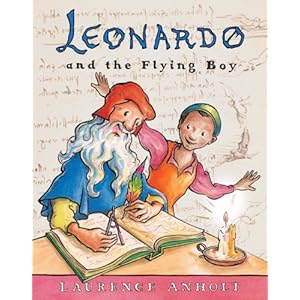
And to think...that Leonardo's life is also captured in a historical fiction text- with a story, about a boy name Zoro who served as an apprentice to Mr. da Vinci as he experimented with "a revolutionary flying machine!" Oh, and it includes an author's note with factual information to help readers' learn, question, understand...a time long ago and Leonardo and the Flying Boy.
And to think...a man, named Pippo the Fool, who was a bullied boy, but also a "clever, determined, imaginative" creator with the odds stacked against him. A man who persevered to win a contest to design the masterpiece Brunelleschis Dome in Florence, Italy that still stands today as a testament to his artistic talent, engineering skills, and out of the box thinking. Pippo's tale defines the Renaissance and an author's ability to marry history and fiction. And of course, it includes excellent information text to build a reader's schema and inspire further learning about a time long ago...
Think of all of that as you embark upon your 5th Grade Unit 3 Inventive Thinking. :)
Polacco's Newest "Need to Read" Books & Some Insight Into Theme
 Patricia Polocco has does it again in her two terrific tales of surviving bullying and an encounter with two life-changing teachers. In Bully, Poloacco, inspired by her own vivid childhood memories of being bullied, cleverly crafts a realistic fiction story that takes on cliques and cyber-bullying-- a sad reality of many kids today. In The Art of Miss Chew, a memoir about the woman who gave our beloved author and artist her confidence and spark to pursue her natural talents, Polcacco shares her own trials tribulations. This story worth telling again and again is also one that recognizes another thoughtful teacher who got to know Patricia and differentiated for her- building her confidence and supporting her success. In both texts, the beginnings are strong, middles engaging, and endings powerful.
  The books can easily be used to teach such important understandings related to: relevant use of any thinking strategy, story elements and how they work together, theme*, author's message*, understanding and applying schema for an author and his/her works, crafts of writing, etc. As always, the possibilities are endless. Plus, I am pretty sure we can find a connection to make the perfect fit into one of your ELA units this year. :)
Please note that each book is a full 32 pages of rich "Patricia Style" text. With that said, there are many possibilities when using books like this in your classroom.
- Read the book aloud in its entirety for the joy of hearing the whole book. Return to it as text to study at a later time.
- Read it a few pages at a time over the course of a several days.
- Read it in three sections (beginning, middle, end) to highlight the structure of the story.
- Listen to the book on a podcast, or watch a video of it being read by the author.
*Universal Theme vs. Theme vs. Author's Message
Because there is always a big debate about these literary terms, I thought I'd do some research and share my learning. Honestly, I am still teasing out my understanding of these terms, but continually growing nonetheless. The main walk away I have is that if kids can gain infer the author's message, and then infer the big, and eventually use text-to-text understandings... they can group and make meaning of like books to enrich their understanding about life and literature.
Universal Theme: an inferred point made about the topic- not just the topic of the work. A statement about life. The "big idea" that spans cultures and time. Courage, Friendship, Honesty, Revenge, Trust, Family, Good v. Evil, Dreams, Hope, Circle of Life
Theme and/or Author's Message: A (often inferred) message or lesson that an author wants you to know or take away from the story.
Ex. Author's Message: Face your fears and you can defeat them.
Universal Theme=courage
Author's Message: Don't wish for what others possess. Be happy with what you have.
Universal Theme=jealousy
Author's Message: Work hard for what you want in life and you can achieve any goal
Universal Theme=dreams
Note: Students struggling with identifying universal themes may need more support in identifying the author’s message or theme of a story first. The third and fourth grade "Theme Lesson" sequences are a good resource for teaching the author’s message or theme. Resource: www.readworks.org
This lesson's description, specifically, is helpful for distinguishing theme/message from universal theme. http://www.readworks.org/lessons/grade4/theme
Monday, October 1, 2012
Building a Shared Discussion

Recalibrating
Each fall, students come together with new classmates and have to revisit the purpose and expectations of these shared discussions. Some teachers begin with a lot of partner work, table talk, and small group work. Others jump right in and add the whole group "Share Square"-either in a morning meeting or at the end of a workshop. However you choose to foster this meaningful talk where kids dig for deeper meaning as well as support and challenge one another- all for the sake of reaching a better understanding of the topic- one thing is for sure: vocabulary development through character education is key.
Support from Stems
Our students need the community language and stems which will provide the words to help them dig deeper into their thinking and that of others. To probe and ponder, students need the: "I respectfully disagree with you because______"; "What evidence do you have to support your thinking?; and "___, I noticed you agreed, what were you thinking?". These and the many other stems that you and your students will come up with, will build that sense of community, that sense of trust, that sense of caring about meeting the conversation's purpose- to gain a better understanding.
Signs and Goals
Many classroom teachers find success when they introduce a couple at a time and only introduce new ones when those focused on have been adopted meaningfully by the students. Often times these stems accompany other goals students set for themselves as they work to enhance and grow their discussions. A quick peek into classrooms will show the impact of students using sign language to further supports this work. Signing allows students to visually see who is agreeing, disagreeing, or wanting to share their thinking. One simple noticing of this silent communication can offer that very quiet classmate a chance to share his/her thinking. These steps and various others you use (anchors*, posted guiding questions, shared texts, etc.) foster the growth of the share. And always keep in mind that just as with Rome...it doesn't happen in a day, but generated greatness. :)
**Be sure to share your building block ideas with others. It takes a village!**
Comment below.
*anchors are those students who do any of the following jobs to support the share:
- start the share by asking the guiding question and calling on a peer
- track data- # of people who share, boys v. girls, types of comments shared
- reflect- person who sums up the gist of the conversation from that share
- refocus- person who gets the group back on track when the conversation veers
- paraphrase- person who says to the long-winded explanation "so what you're saying is..." so that the most important part is captured for the group
Subscribe to:
Posts (Atom)