Pages

Sunday, September 29, 2013

What's a Word?


Powerful Pronouns:     
Me vs. Us*

 What is the impact on your students when you say…

“Show me.”                   vs.             “Show us.”                       

“Tell me.”                      vs.             “Tell us.”                        
                 
“Explain to me.”            vs.            “Explain to us.”                 
     
“Tell me why...”             vs.             “Tell us why...”                 

“Help me understand…” vs.            “Help us understand…”
     
                  “Describe for me…”        vs.             “Describe for us…”                                                                        

* Usthe class, our class, your classmates, our community.


Which pronoun do you find yourself saying most?

Who's invited in? Who's tuning in?
Who's tuning out?

Math From Me? Yep.

http://calgaryscienceschool.blogspot.com/2011/10/inquiry-in-math.html 
This site is one to check out!

Citing Support

When it comes to research it can often seem easier to actually read, record, and paraphrase than it is to cite the research we use! How many times do we try to help our students understand the correct ways to cite, only to be tangled up on our own words? Well, here is a link that may just be your (and your students') saving grace. It offers students an easy way to learn how to cite their sources. 

As you know, our students are very much aware of the importance of the practice.  (Ask just about any Buckner Bear and they'll be able to fill you in on how it's "stealing someone else's words to copy.") They really do understand why they need to do it, but actually understanding how to do it is another story altogether. These helpful tools http://www.easybib.com/ &  http://citationmachine.net/index2.php may just offer the modeling needed to make the format of citing sources manageable and--one day-- part of their schema.  

This is the citation that appears when you simply type in the Title or ISBN of the book!
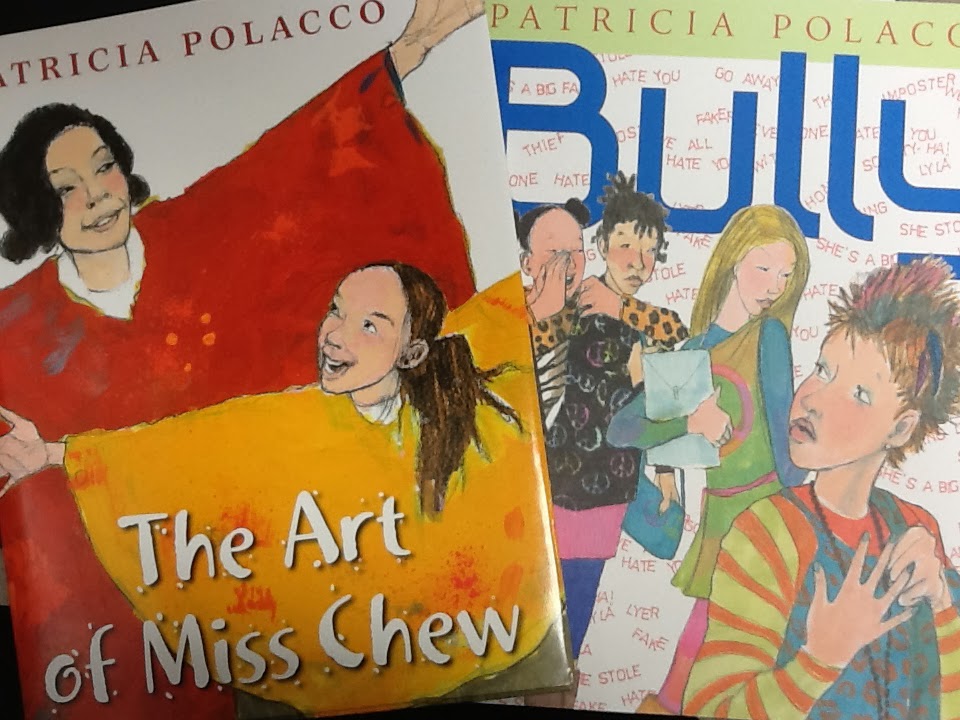
Polacco, Patricia. Bully. New York: G. P. Putnam's Sons, 2012. Print.

Tuesday, September 10, 2013

Upping the Ante: Challenge Rewards Go Physical

The Internet is a wonderful, crazy, and scary thing. Apparently anything you search is "trackable" and people you've never met notice your online activity. With that said, I got a very wonderful, crazy, and scary (I thought maybe I'd done a little copyright infringement issues with some copying and pasting of images or info.-not that I've ever done that, of course) phone call yesterday from The Great Books Foundation (Junior Great Books) National Director of Sales. He noticed my "Two Challenges, Two Teachers- Fifty Winners" JGB Challenge wanted to offer our teachers something for their participation. So...in addition to the sheer joy you and your students will feel from engaging in JGB stories 5 times this year, AND the increase in reading proficiency and critical thinking abilities for you and your students, NOW you can also receive a Sampler kit worth $99 compliments of Mr. Thomas Kerschner and The Great Books Foundation. "We will send you a Sampler for each of your teachers who completes the challenge." Who can resist now? If you have not had the opportunity to read the finer details of the challenges, please check out www.theliteracyconnectionbes.blogspot.com Post Below and let me know when you're ready to start!

Have a great day! Who knows what wonderfully, crazy, scary things might happen to you!

Sunday, September 8, 2013

Two Challenges- Two Teachers- Fifty Winners: Junior Great Books & Vocabulary Conscious Teaching

I've got a challenge for you. Actually, I've got TWO. Taking part in this adventure is a win-win no matter how you look at it and it's sure to result in increased student learning along the way.  

Is your interest piqued? Do you want to know more? Get a little info before you join in, try something, hop on board, give it a whirl?  Ok, here's the nitty gritty- remember these are TWO separate options for TWO different teachers- or ONE eager beaver who would like to try both. Wowza!

OPTION 1: Junior Great Books Stories  (within Literacy Workshops in grades K-5)
A significant body of research links the close reading of complex text—whether the student is a struggling reader or advanced—to significant gains in reading proficiency and finds close reading to be a key component of college and career readiness. (Partnership for Assessment of Readiness for College and Careers, 2011, p. 7)

A significant body of research links the close reading of complex text—whether the student is a struggling reader or advanced—to significant gains in reading proficiency and finds close reading to be a key component of college and career readiness. (Partnership for Assessment of Readiness for College and Careers, 2011, p. 7)
What: Intentionally teach using the Junior Great Books stories and methods that include multiple readings, vocabulary practice, directed notes, shared inquiry discussion, and a short written component. The stories selected would meet the ELA units' standards and coincide with the theme.  At no point would this be extra work. 

How many stories/cycles? FIVE- You would be agreeing to offer JGB experiences FIVE times a year. 

Why: JGB offers direct connections to the CCSS/KCAS.

  • A questioning stance that extends ans scaffolds critical thinking
  • Text complexity 
  • Multiple readings and close readings* of text
  • Text-dependent, text-specific questions requiring responses with specific and relevant evidence
  • Analytic and narrative writing with the use of textual evidence

*see article from Educational Leadership "Closing in on Reading" by Nancy Boyles http://www.ascd.org/publications/educational-leadership/dec12/vol70/num04/Closing-in-on-Close-Reading.aspx

Purpose: To do a little action research to document the benefit of intentional instruction with JGBs and the WHYs listed above. Caveat: We would to need to use assessment data from your class to see the impact of this practice on students within your classroom. 


*Check out this link of a Shared Inquiry Discussion video with great examples of how JGB supports and sets the rigor for finding textual evidence.
Text used The Stories Julian Tells
http://www.greatbooks.org/programs-for-all-ages/junior/jgbseries/grade-2/

OPTION 2: Vocabulary Conscious Teaching (10-15 min. 4-5 days/week) 4th-5th grades
Studies and reviews of research over the past three decades have shown that the size and depth of elementary students' vocabulary is associated with proficiency in reading comprehension and that instruction increases reasders' vocabulary results in higher levels of reading comprehension (e.g., Baumann, Carr-Edwards, Font, Tereshinski, Kame'enui & Olejink, 2002; Beck, Perfetti, & McKowen, 1992; Kame'enui, Carine, & Freschi, 1982; Stahl & Fairbanks, 1986).
What: Intentionally teach and offer your students vocabulary instruction and practice with Greek and Latin affixes (prefixes/suffixes) and roots, thus supporting your readers, writers, scientists, mathematicians, social scientists, and thinkers in general. The words selected would come from research-based sources, the ELA units, and/or connections to content in other areas. 

How often and what would we do?    10-15 min./day     The link below is a text co-authored by Tim Rasinski, vocabulary and fluency guru and recent OC speaker!). The authors offer a set of "engaging instructional ideas for the use of Greek and Latin derivations to teach vocabulary and provide classroom-based examples of how a morphological-based vocabulary" implementation can impact students and teachers.

Other resources may include: Words Their Way, Word Nerds, Word Savvy and other texts you've used.
 
Why is it important to study Greek and Latin word parts?
    • Over 60% of the words students will encounter in school textbooks have recognizable word parts; and many of these Latin and Greek roots (Nagy, Anderson,Schommer, Scott, & Stallman, 1989). I'd contend that even if you don't ever use a textbook, students would encounter the words in the articles and texts you provide for them.
    • Latin and Greek prefixes, roots, and suffixes have predictable spelling patterns.(Rasinski & Padak, 2001; Bear, Invernizzi, Templeton & Johnston, 2000).
    • Content area vocabulary is largely Greek and Latin-based and research supports this instruction, especially for struggling readers (Harmon, Hedrick & Wood, 2005).
    • Many words from Greek and Latin word parts are included in “Tier Two” and “Tier Three” words that Beck, McKeown, and Kucan (2002) have found to be essential to vocabulary word study.
    • Knowing Greek and Latin word parts helps students recognize and gain clues to understanding of other words that use known affixes and roots(Nagy & Scott, 2000).
    • “One Latin or Greek root or affix (word pattern) aids understanding (as well as decoding and encoding) of 20 or more English words.” 
    • “Since Spanish is also a Latin-based language, Latin (and Greek) can be used as a bridge to help Spanish speaking students use knowledge of their native language to learn English.” 
    • Learning Greek and Latin affixes and roots may help reduce the literacy gap.   

Purpose: To do a little action research to document the benefit of intentional instruction with vocabulary and the WHYs listed above. Caveat: We would to need to use assessment data from your class to see the impact of this practice on students within your classroom.

So, anyone on board? Anyone interested in collaborating in this effort to increase students' reading achievement? Offer readers opportunities to improve on a number of level?

If you are up for the challenge, please let me know and we'll get started. Remember, it's a journey that setting up the participants for success. 


Wednesday, May 1, 2013

Pacing, Pulling, and Pondering with MENTOR TEXTS: Reflecting and Planning

Whether you find yourself clocking hours pacing around your room as you proctor your students taking the K-PREP, or you just notice your brain moving from this year to thinking about next year, it's about the time of year to ponder and reflect on the successes and "need to repeat" strategies from past year and the "want to dos" for the approaching August start date. Since you'll be passing by your bookshelves every so often as you pace or digging into them when you inventory books for Jennifer, this might be the perfect time to ponder MENTOR or "Touchstone" TEXTS for the 2013-14 school year.

You know as well as I do how easy it is to collect piles and folders of mentor texts (e.g. books, articles, poems, etc.). Heck, I could probably be labeled your "pusher" at times! And though I've thought it and a said it several times over the last few years, "You really only need 3-4 per type of writing", I doubt I've been successful as practicing it or really preaching it. In fact, I'm pretty certain I could be called a hypocrite in certain circles. But, give me a chance, if you will, to revise my thinking about mentor texts and consider future possibilities with the help of some amazing mentor writers and instructional leaders to back me up. Here goes:


"Most important, I've learned that  we don't need hundreds of texts. It's easy to fall into the trap of believing that we do....In my experience, though, there are many, many ways a single well-written text can be used to teach students in conferences....In each of my two collections of mentor texts-- one for primary grades and one for upper grades- I have about twenty-five texts. That's it. In the collection I use for primary grades, I have picture books and short texts: a couple of memoirs, a few list books, several number books and alphabet books, and some nonfiction books. I have one good anthology of poems. In my upper-grade collection, I have four or five memoirs and the same number of short stories. I have several picture books. I have a few editorials and nonfiction feature articles. And I have one good anthology of poetry.  (p.129-130)
                                                        -Carl Anderson, How's it Going?

Should you find yourself wondering about how to select these mentors, Carl does offer some suggestions.

Some of Lucy's Favorites
  • Consider Texts We've Already Read to Students- While this advice might  seem "a day late and a dollar short", I'd contend it's perfect timing. All this time pacing or inventorying provides you with the opportunity (while you are monitoring your students, of course) to consider which texts are jam-packed with craft techniques, structures, and content you wish to highlight and use throughout the year. If you find that you absolutely LOVE using Alice McLerran's The Mountain Who Loved a Bird,  and you used it for teaching science concepts later in the year, anyway, why not introduce it in August and let the kids go ahead and fall in love with the story, the structure, the language, the artwork? How much more powerful will it be when you return to as a mentor over and over again (when studying narratives, or beautiful language, or personification, or purposeful repetitive writing). Why not?
  • Cast a Wide Net- as Carl suggests, don't limit yourself to long picture books. This is an easy one for us as we have always cut clippings from newspapers or magazines, or downloaded from online sources. The shift may be feeling comfortable using those nonfiction texts, poems, and within our few few weeks of school as we support our writers in Building a Literate Community- as we offer invitations to write from sparks in a variety of forms, as we immerse our kids in ALL kinds of writing.  (situations, forms, audience, purposes, and styls)
  • Cut Excerpts from Longer Works- Although it's so temping to feel like we have to use the ENTIRE text when we show students how to write in a certain way, it's totally unnecessary to always feel like we have to have to reexamine the WHOLE text. Carl contends that sometimes just a few sentences will do the trick- show the student the desired craft technique, or demonstrate the complexity of a sentence. The key is that that the child already knows and appreciates the text. Then they will seek to emulate that writer so they can have the same desired affect on their reader. So, consider cutting out a part to have that available for later use.
  • Use Student Writing-As a whole, we are successful with
    Student Writing -Kindergarten
    this...sometimes. As you support your students in selecting their best writing for this year's SHOWCASE PORTFOLIO, take time to scout the room for that perfect model text for next year. Make the effort to copy or save it on  your drive so  you have access to it in AUGUST! Too often we see it, love it, and then lose it because it gets put into a folder or taken home. What student written texts will you save and use... or pass on for a lower grade to use. (Always consider your colleagues when you search for student models).

    Enlist the Aid of Colleagues, the LMS, LC (me!), and your future students- though it's easy to get swept away in what we know and love, there are always new idea and perspectives out there. Ask someone else what they have found success with using. Better yet, put it in your plans for the fall (August is not technically fall, I know, but the powerful alliteration called me to use that word.) to have your future students search for mentors they want to have available in the class.
  • Write Text Ourselves- Carl suggests that you never underestimate the power of using your own writing as mentor texts. You will have the desired traits, craft techniques, processes, content, and focus, as well as a way for your students to immediately see you as a fellow writer.
  • Final thoughts: Consider the kids' interests, the power of variety, the opportunity for emulation.
 Though this list is in no way exhaustive, it certainly offers food for thought. It gets us reflecting on our past year and the mentors we loved and those we wish we'd had. It also offers us some of our next steps- whether that means we copy or pull from this year's collection or student work, or get looking for something we've never had before-we will at least have direction. At this point, you've: taught the new ELA units; know the demands of the standards; better understand the connection of the themes, and experienced much of the variety and types of writing the kids are called to do.  At this point, you're ready to pace and/or check, ponder, pull and list the best little collection of MENTOR TEXTS.


Likeable Links
Franki Sibberson finds literary nonfiction provides rich and varied writing models for elementary students. She shares some of her favorite mentor texts:


If you're looking for new nonfiction text models, you might want to explore Choice Literacy'sPinterest board Great Nonfiction for Kids. We add to it weekly, and it currently includesmore than five dozen annotated children's books:
 
http://pinterest.com/choiceliteracy/great-nonfiction-for-kids/What are your "tried and true" Mentors (models, touchstone) Texts? Please post!
"Eleven" by Sandra Cisneros is certainly on my list!
The Big Rock by Bruce Hiscock
My Worst Day column in Discovery Girl Magazine is a goldmine! (Simply choose a relevant and engaging topic for your new class of kids...when you meet them.)

Resource:
How's it Going? by Carl Anderson (Heinemann)
Other supporters of mentor texts- Lucy Calkins, Katie Wood Ray, Ruth Culham, Ralph Fletcher, Jeff Anderson

Tuesday, April 30, 2013

Transition Words: Powerful Tools for Developing Ideas and Moving Readers


I had and Aha! today as I delved into some research related to developing student writers and the ELA curriculum. I had been pondering reasons for the lack of development in students' writing. What is the hang up? What is impeding their ability to really develop a topic sentence (idea)? At that point, I saw something on a Continuum for Opinion/Argument Writing- Grade-by-Grade. What I was was the transitions cell that stated:
"I connected my ideas/reasons with my examples, explanation, and experiences using transition words like for example and because. I connected one reason to another (or example) using words like also and another."

That's the moment when I realized that maybe I'd not done enough in the past to support writers with using transition words to further develop their ideas! Maybe I'd just plain forgotten about their importance in "triggering" a supporting example or explanation! If that is the case, than I've cheated my students (and sadly, maybe even your students) from a method writer's use to develop ideas in a paragraph and moving a reader from paragraph to paragraph. (Insert apology here) However, the is hope! We still have time to equip our kids with this tool and support them in AIMING HIGH with those they select. Motivating writers to "write like a 5th grader" can offer your students that exciting goal and stronger language to boot! 
While a poster or table papers may suit you just find in your classroom, our 3rd grade guru, Emily Esarey, plans to create bookmarks for her writers. Might be these OPINIONish transitions on one side and NARRATIVE and INFORMATIVE on the other. We'll just have to see what she cooks us and posts on Pinterest! ;)
Here's the gist of the Opionionish Transiton Words our writers are expected to use with in their writing.Of course, the list highlights just a few examples of the myriad of possible transitions writers use. Mentor texts provide some excellent examples to add to your class list!
 
Becoming Stronger Writers with Transition Words! (Some Opinion Writing Focus)
Aim HIGH!


5th graders use:

Consequently
Specifically
 

4th graders use:


For instance,

In order to…

In addition

Although...

3rd graders use:


For example,

…because…
 
, therefore


since

also

Another…
 

2nd graders use:


because

and

also
 
Just one example of how a writer might include transitions to develop ideas and guide a reader. Consider how using a variety and some 4th grade transition words might have added to this writer's writing.
 
This 4th grade writer also attempted to use transitions. As you can see, the most successful transitions occurred between paragraphs as the writer worked to move a reader from one paragraph idea to another. When it comes to transitioning between sentences in a paragraph however, this is where a list of possibilities might really be valuable to this writer. Although the writer does a great job supporting his main idea (video games are bad for your eyes), he/she does not use transitions to connect the support to the further support. Check out the last couple of sentences to see where he/ she might have added a good transition word. This one is certainly on the way to the stars!